What Hogan’s Global Study Means for American Leadership, Spokane, WA
by Dr. Tyler Gerdin, PsyD, ABPP, ACC, Psychologist, Certified Coach (ICF)
You’ve certainly heard this one: the brilliant individual contributor gets promoted to manager, and overnight the organization loses a great engineer and gains a mediocre (or worse) boss. We laugh because it’s true—and because we’ve all either been that person or worked for them.
Hogan Assessments’ new global study, The Leadership Divide, puts hard data behind the punchline. And the findings are worth sitting with.
What the Study Actually Asked
Most leadership research starts at the top. It studies the people who already hold the corner office and asks, “What makes them tick?” The trouble with that approach is circular: if you only study who got promoted, you end up describing the behaviors that get people promoted—not the behaviors that make them good at the job once they’re there.
Hogan flipped the question. Drawing on responses from nearly 10,000 workers across 25 countries—and comparing them against a benchmark of more than 21,000 executives in their global database—they asked the people who actually do the work: What do you want in a leader?
The gap between those two pictures is the “leadership divide,” and it’s bigger than you’d expect.
The Punchline: No Overlap
Here’s the finding that stopped me. When Hogan lined up the top five competencies that today’s global executives reliably demonstrate against the top five competencies workers say they want, there was zero overlap. None.
Executives tend to show up as inspiring, competitive, polished presenters who take initiative and drive innovation. Impressive stuff. The behaviors that land you the promotion.
Workers, meanwhile, said they want communication, sound decision-making, accountability, integrity, and the ability to actually lead a team—each endorsed by roughly 97% of respondents. Notice the theme: every one of those is a trust behavior. People aren’t asking for charisma. They’re asking for someone they can count on.
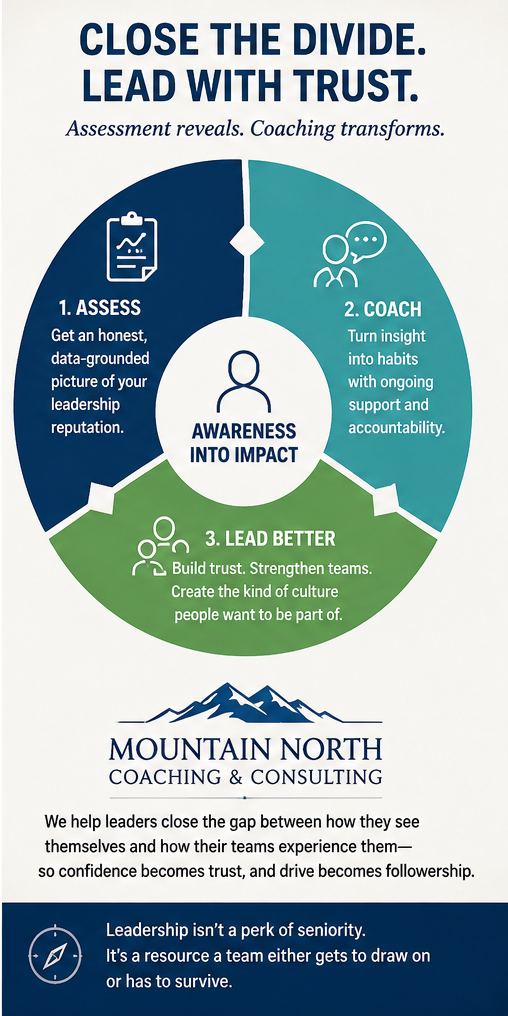
This matters more than it might sound. As Hogan’s research reminds us, a leader’s personality isn’t just a personal quirk—“who you are is how you lead.” And when leadership goes sideways, the cost is human. The study cites the sobering finding that for a majority of people, the most stressful part of their day is their direct boss. Leadership isn’t a perk of seniority. It’s a resource a team either gets to draw on or has to survive.
Identity vs. Reputation (The Idea That Changes Everything)
One of Hogan’s foundational distinctions is between identity and reputation. Identity is the story you tell yourself about who you are. Reputation is everyone else’s experience of you. Here’s the kicker: reputation is the part that’s observable, measurable, and that actually predicts whether you get hired, promoted, or shown the door.
Most of us coast on identity—“I’m a good listener, I’m decisive, I care about my people.” But your team isn’t grading your intentions. They’re grading the footage. The leadership divide is, in many ways, just the distance between those two.
So What Are American Leaders Like?
The U.S. regional data tells a familiar story. American organizations tend to reward leaders who command a presence, influence others, present ideas with polish, take initiative without being asked, foster innovation, and drive performance to beat the competition. We love a leader who can work a room and rally the troops. It’s practically baked into our cultural DNA.
What American Companies Actually Want
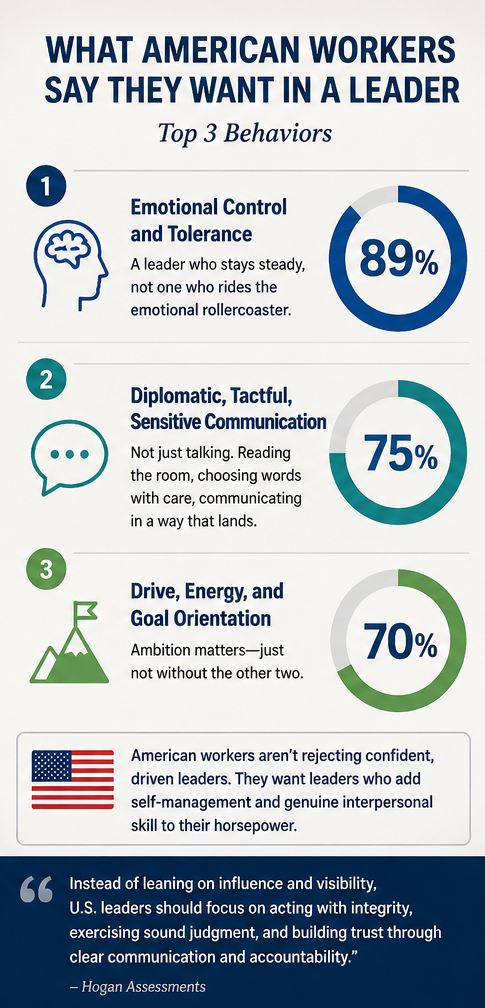
The disconnect shows up the moment you ask U.S. workers what they value. The top three behaviors they want in an ideal leader:
- Emotional control and tolerance — 89%. By a wide margin, the number-one ask. People want a leader who stays steady, not one who rides the emotional rollercoaster and makes the whole team buckle their seatbelts.
- Diplomatic, tactful, sensitive communication — 75%. Not just talking. Reading the room, choosing words with care, communicating in a way that lands.
- Drive, energy, and goal orientation — 70%. Importantly, ambition did make the list. Americans haven’t stopped wanting drive. They’ve just stopped wanting it without the other two.
Read those together and the message is clear. U.S. workers aren’t rejecting the confident, driven leader. They’re asking that leader to add self-management and genuine interpersonal skill on top of the horsepower. They want the engine and the steering.
Hogan’s own takeaway for American executives lands the plane: instead of leaning on influence and visibility, U.S. leaders should focus on acting with integrity, exercising sound judgment, and building trust through clear communication and accountability. That’s the foundation that turns confidence into something people will actually follow.
How American Leaders Should Respond
If you’re a leader reading this and feeling a little exposed—good. That feeling is called self-awareness, and it’s one or the rarer, valuable leadership commodities I know.
Here’s the trap to avoid: don’t read this study and conclude that drive and confidence are liabilities to be suppressed. They aren’t. The issue is the overused strength—the confidence that curdles into arrogance, the conviction that hardens into not listening, the energy that under pressure spikes into volatility. Hogan’s research is consistent here: what gets you promoted is not always what makes you effective, and our strengths are most dangerous precisely when we stop watching them.
The response isn’t a personality transplant. It’s calibration. The most effective leaders learn to read context and adjust—knowing when to push and when to listen, when to dial a behavior up and when to ease off. That’s not softness. That’s range. And range is trainable.
Where Assessment and Coaching Come In
Assessment makes the invisible visible. The single hardest thing about the identity-versus-reputation gap is that, by definition, you can’t see your own blind spots. A validated assessment—the kind of work I do with the Hogan suite and tools like the EQ-i 2.0—gives a leader an honest, data-grounded mirror. Not the story you tell yourself. The footage. It surfaces the day-to-day strengths, the values driving your decisions, and the derailers that emerge under stress before they cost you a key team member.
Coaching turns insight into habit. Awareness alone doesn’t change behavior—if it did, every New Year’s resolution would stick. Coaching is the structured, ongoing work of taking what the data revealed and building new defaults: pausing before the reactive email, asking one more question before deciding, naming stress out loud instead of letting it leak onto the team. Having another thinking partner can help you see blind spots and sift the wheat from the chaff in your thinking. A coach shouldn’t primarily be bringing you ideas to your problems—they help you to tap your expertise to optimally solve problems in your own way.
The leadership divide noted in the Hogan study notes a development opportunity hiding in plain sight. The leaders who close it aren’t the ones with the most natural charisma—they’re the ones willing to look honestly at the gap between who they think they are and how their teams actually experience them, and then do the patient work of narrowing it.
That work is eminently doable. And it’s exactly the work worth doing.
Curious where your own leadership reputation stands? At Mountain North Coaching & Consulting, I help leaders use assessment and coaching to close the gap between how they see themselves and how their teams experience them—so confidence becomes trust, and drive becomes followership. Reach out to start the conversation.
Source: Hogan Assessments, The Leadership Divide: Global Insights on Who Leads vs. Who Should (2026).