How I Use the Hogan Assessment with Leaders and Teams
By Dr. Tyler Gerdin, PsyD, ABPP — Mountain North Coaching & Consulting, Spokane, WA
There’s a frustration I hear often from the leaders I work with here in Spokane. It sounds like: “I’m working hard, I’m doing everything right, and somehow it’s still not landing.” A capable, well-intentioned executive—experienced by the team as distant, or impatient, or impossible to please. The gap between who we believe we are and how we land on other people is one of the most expensive blind spots in professional life.
It’s also one of the most workable—once we can see it. That’s the work the Hogan assessment was built for, and it’s become one of the tools I reach for most. But to explain why I trust it, I have to start with the one idea that makes Hogan different from almost every other personality tool: it doesn’t measure who you think you are. It measures your reputation.
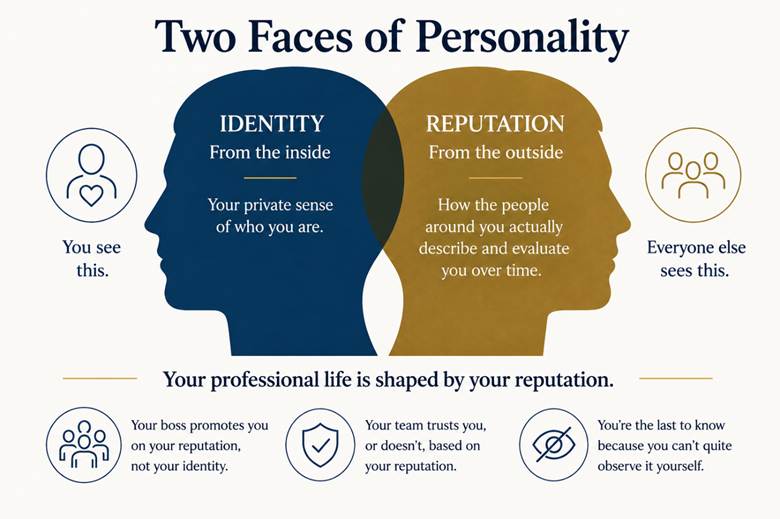
Two faces of personality: identity and reputation
Robert Hogan, who built these instruments, draws a sharp line between two faces of personality. Identity is personality from the inside—your private sense of who you are. Reputation is personality from the outside—how the people around you actually describe and evaluate you over time.
Our culture (and most conversations in psychology) focuses most of the attention on identity. However, reputation is the more powerful of the two. It’s more stable, more predictive, and it’s the one that governs your professional life. Your boss promotes you on your reputation, not your identity. Your team trusts you, or doesn’t, based on your reputation. And it’s nearly impossible to see from the inside—you’re the one person who can never quite observe it, because you’re standing behind your own eyes. Everyone else in the room sees it clearly; you’re the last to know.
“But I fill it out myself—how can it measure what others think?”
Every thoughtful person asks this, and it’s exactly the right question. You answer questions about yourself, alone; nobody interviews your colleagues. So how can the result measure their perception rather than just yours?
This is what makes the Hogan genuinely unique. When Hogan built and refined these scales, the team didn’t just collect people’s self-descriptions. They also gathered descriptions of those same people from the people who knew them—managers, peers, direct reports, spouses. A questionnaire item earned its place on a scale only if the way you describe yourself reliably tracked the way independent observers described you. The self-report is the input; the observers’ point of view is the yardstick the whole instrument was calibrated against. (The items were even written to be non-obvious, so it’s hard to game the test by guessing what “looks good.”)
That’s the move that resolves the paradox. You answer questions about yourself—but those questions were chosen precisely because your answers predict what other people will say about you. Hogan reads your self-presentation through a lens ground entirely from other people’s eyes.
One honest note: Hogan predicts and estimates your reputation; it doesn’t literally poll your colleagues. The claim is actuarial—”people who answer the way you did are typically described by others as ___.” When I want literally-measured, multi-source reputation, that’s what a 360 instrument is for, and Hogan publishes one. In practice the prediction is usually accurate enough that the distinction matters more for honesty than for results—but I’d rather you know exactly what the instrument is and isn’t.
The three lenses
The rest of the suite follows naturally. It’s three instruments, each surveying a different layer of your reputation:
- The Hogan Personality Inventory (HPI)—the “bright side.” Your reputation at your best: what people rely on when things are going well.
- The Hogan Development Survey (HDS)—the “dark side,” or what I call your derailers. The tendencies that emerge under stress and pressure; strengths that, overused, start to work against you. The confident leader who tips into arrogance; the careful one who tips into paralysis.
- The Motives, Values, Preferences Inventory (MVPI)—the “inside.” Your core drivers and values: what motivates you, where you’ll thrive, and where you’ll quietly chafe.
Together they tell a story: who you are on a good day, who you become on a hard one, and what’s fueling the whole engine.
Why I trust the science
I’m a clinical psychologist by training, and I don’t put my name behind instruments I don’t respect. Hogan was built to predict behavior in the workplace; its bright-side measure maps onto the Five-Factor Model (the most empirically robust framework personality science has produced); and its scales were refined and validated over decades by tying self-report to how observers actually describe and rate the same people, with well over 250 criterion-related studies linking them to real, measurable job performance. It’s reviewed by independent authorities, not just its own publisher. Hogan has data on a wide variety of businesses and specific job titles. In short, Hogan has been built specifically for work with business and industry leaders.
While I have a certain affection for the Myers-Briggs, Enneagram, and StrengthsFinder, etc. . . their limited and uneven evidence base, inconsistent reliability, and inadequate links to real workplace outcomes mean they should be used very cautiously—and never as primary tools—in serious work in business. In their defense, these tests were not made for use in the business setting. That’s why I use the Hogan—it was made specifically for industry and has the key scientific/psychometric data to prove that it is reliable and valid to answer the questions business leaders have.
In tech, I hear:
- “My best engineer just became a manager. Will the very thing that made her brilliant as an individual contributor start to get in her way now that she’s leading people?”
- “We scaled from twenty people to two hundred in eighteen months. Am I still the right kind of leader for the company we’ve actually become? Should parts of this ledaership be done by another person? What kind of person?”
- “When the next launch slips or the runway gets tight, how do I really behave under that pressure—and what does my team quietly brace for?”
- “Who on my team is genuinely ready for the next level, and who just looks the part?”
In healthcare, I hear:
- “I was an excellent clinician, and now I’m running a department. Do those skills even transfer—or am I starting over?”
- “How do I lead physicians and specialists who know far more than I do about their own work?”
- “Why does conflict on my unit either blow up or go underground, but never just get resolved?”
- “My people are exhausted. Where am I unintentionally adding to the load instead of buffering it?”
How I use it—with individuals and teams
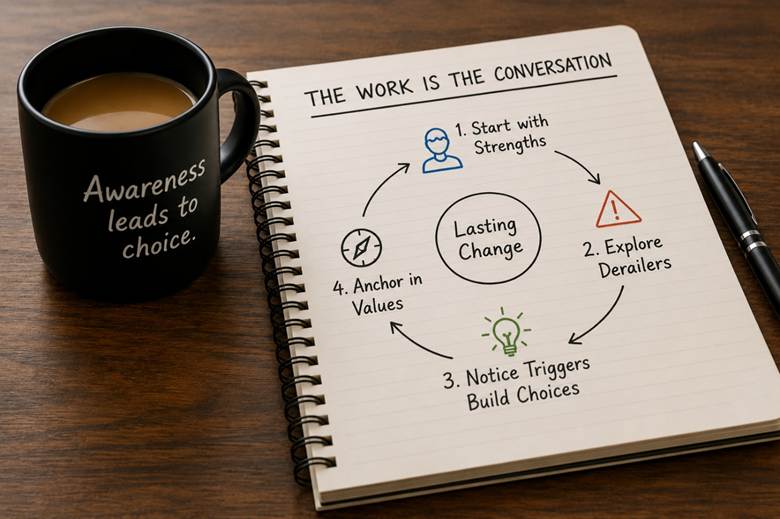
A Hogan report is not the work. The conversation is the work.
With a leader, I use the profile as a mirror we look into together. We start with the bright side, because people deserve to hear what’s genuinely strong about them before we touch anything tender. Then we move to the derailers—and this is usually where the room goes quiet in the best way. Most people recognize their HDS profile instantly, often with a rueful laugh: “Oh. So that’s what’s been happening.” From there the work is practical and humane: we’re not trying to amputate a derailer (these are strengths in costume), but to notice the conditions that switch them on and build a few repeatable choices for those moments—all anchored in what the person actually values, because change that fights someone’s core motives won’t survive a busy week.
With teams, Hogan gives a group a shared, non-judgmental language for how they work together. We map where the team is deeply strong, where everyone is quietly leaning the same way (often a hidden risk), and where values genuinely differ. That last one is where a surprising amount of team friction actually lives—so much of what gets called “a personality clash” is really a values mismatch. When a team can name that out loud, in language that makes no one the villain, the temperature in the room drops. I’ll often hear them using their Hogan language weeks later, unprompted: “That’s my Bold talking,” or “We’re all going into Diligent overdrive—let’s slow down.” When that happens, I know the tool has done its job.
The real point
For all the science behind it, what I love about Hogan is profoundly human. Self-knowledge is the beginning of choice. When a leader can finally see the reputation they’ve been broadcasting without knowing it—and a team can finally name the patterns they keep tripping over—people stop being at the mercy of their blind spots and start making different choices, on purpose.
That’s the moment I’m always working toward. Hogan just happens to be one of the most rigorous, trustworthy mirrors I’ve found for getting there.
Curious whether a Hogan-based assessment might be useful for you or your team?
I work with executives and teams across Spokane and the Inland Northwest, and I’d be glad to talk it through. Reach out anytime—drgerdin@gerdinpsych.com or 509-676-4313.